Building Environments for Thought
Generative AI and the practice of inquiry
The co-evolution of intellectual work and its environments
Latent Writing asks what changes when a medium conditioned by earlier writing can also compose a reply. Here I want to follow that question into more practical directions. What does this mean for us as we move into modes of creative work centered around these new technologies? I think this will require some simple definitions of the relations between parts of the systems involved, and how they create what we call ‘agency’.
For example, humans use tools to create artifacts, and this activity takes place within an intellectual environment. Tools extend the human capacity for action, artifacts preserve the results of actions, humans cooperate to develop practices oriented around tools and artifacts, and environments provide the conditions for action. Importantly, artifacts, tools, and environments are not mutually exclusive categories of things but describe roles that the products of intellectual activity can occupy. An artifact becomes a tool through its use. A collection of tools, artifacts, and practices can then become an environment when their organization begins to condition what further actions are possible. A particular program is an artifact of software development, but can become a tool when used to perform additional work. That tool may then go on to produce new artifacts, and some of these might become tools themselves. Through their continued organization, use, and distribution, these relationships can form increasingly sophisticated environments for intellectual activity.
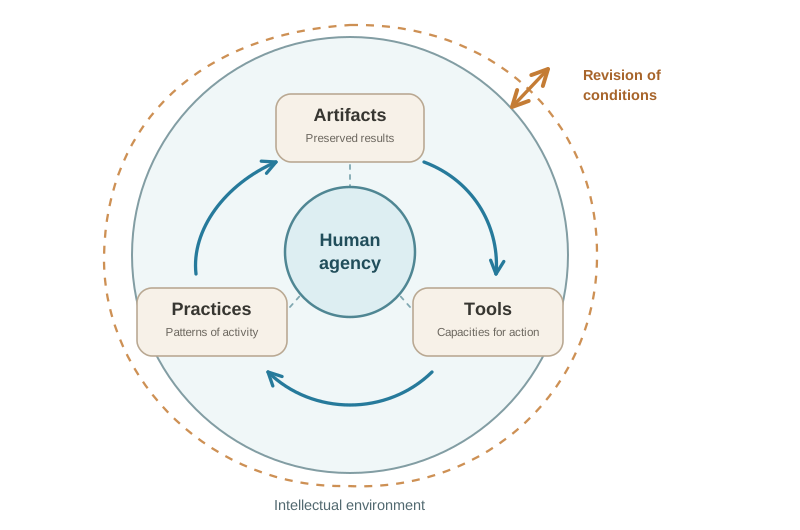
The relationship is cyclical. We are born into and inherit an intellectual environment; we act within it, and then we produce things that may change the conditions of our future activity. This environment is not simply a background, and agency is not independent of it. Each creates the possibilities of the other. Generative systems accelerate and broaden this process, but do they fundamentally change it? Software is an artifact of human design, but large classes of software are also used for productive ends, to create artifacts—often more software. This recursiveness is one of the drivers of the economy and productivity growth in recent generations. Now, again, machine-learning models and coding harnesses are themselves computational artifacts—the former products of training on data by other software—but when deployed as tools, they can participate in the creation of further artifacts, including software that becomes part of the working environment. Following through on this process, the subsequent structures of that environment will become increasingly available for revision within the same process of inquiry they support.
I think that the resulting possibility is not simply an expanding collection of computational tools. Not merely more options for software, but a new relationship between ourselves, our tools, and the ability to change the environment. It is a more continuous relationship between constructing the actual conditions of intellectual activity and then acting within those conditions. Our environment becomes a product of earlier inquiry as well as an instrument through which subsequent inquiry can develop.
Where access to information once depended on physical collections, institutions, and specialized expertise, much of the preserved history of human knowledge is now available through a common technical medium. The emerging process I want to investigate lies in that movement between thinking and making, and in particular, the timescale of that movement.
When environmental change enters the timescale of thought
Consider the construction of a library. It represents more than an accumulation of books: the selection, classification, and organization of its contents create an environment where particular kinds of inquiry become possible. Historically, the construction and substantial reorganization of such environments could require years, lifetimes, or the coordinated activity of institutions and communities.
The productive cycle nevertheless continued. People worked within existing arrangements they were born into, developing new artifacts, tools, and practices and gradually transforming the conditions inherited by others. Much of this transformation occurred across individuals and generations, rather than within the immediate experience of a single person. Over many generations, scholars could look back and see these changes more clearly, through a growing lens of social capability for change. Industrial technologies, followed by computing and the internet, progressively changed the speed and scope of this pattern. The relevant development was not only that more information became accessible, but that the means of organizing and manipulating it became increasingly available. Software introduced a particularly interesting possibility: the same technical medium could be used both to perform intellectual work and to construct new tools for that work.
Generative models and coding systems may represent yet another substantial change in this relationship. They make it increasingly possible to develop or modify software in response to an immediate intellectual intention. Rather than adapting one’s inquiry to an existing tool, one can begin to adapt the tool to the inquiry, potentially within the same episode of thought.
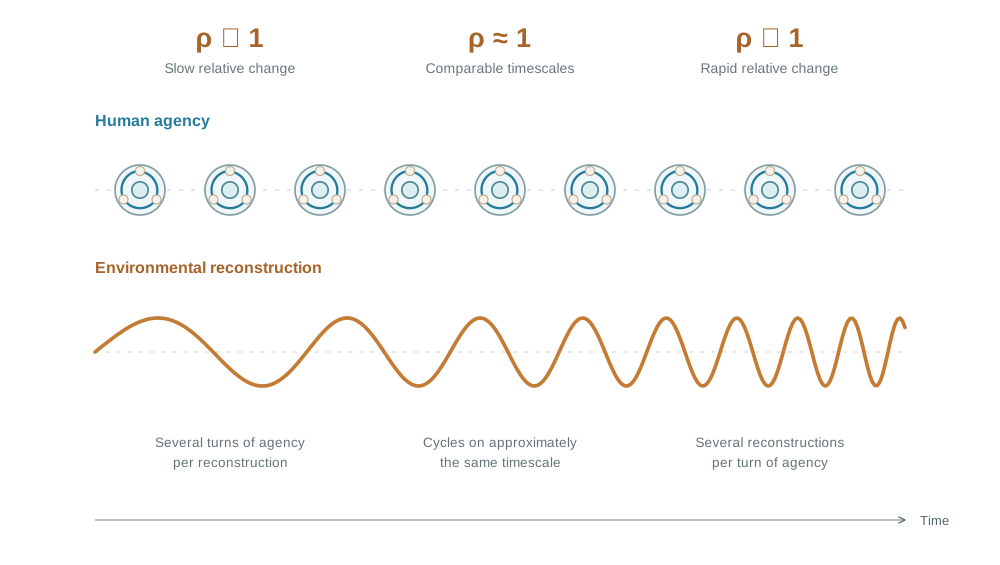
We might describe this shift by considering two characteristic timescales:
: the duration of a single representative cycle of human intention, action, and feedback.
: the duration associated with a meaningful iteration of change in the intellectual environment.
Their ratio is:
This is just a simple model, as neither human thought nor environmental changes unfold in discrete, uniform cycles. Still, the relative timescales provide a way to consider how their relationship changes. It is important to keep in mind that these temporal changes relating to environmental reconstruction refer to a change in the tools, representations, or practices available for subsequent activity, rather than simply the production of another artifact. Mere production in a particular instance doesn’t itself present a qualified change to the larger environment unless integrated into future iterations.
Something about this process feels familiar, something that has developed over time as I’ve gained more experience—from early academic work through dissertation research and then into industry, in roles spanning different disciplines and teams. It is core to the scientific process itself and to modern data science. Questions lead to experiments, experiments to unexpected observations, and observations to new questions. We iterate, focus action on evidence, notice when common workflows tend to aggregate and when some questions need to be repeated—and go from one-off notebooks and ideas to more mature theories, processes, and pipelines. Something about this relationship is changing, though. Now our technology increasingly allows us not only to retrieve and interpret information, but to construct the tools through which we encounter it. The distinction between using an existing environment and developing a new one becomes less rigid. I might begin with a question, develop a way of organizing the relevant material, discover that the organization is inadequate, and modify the software to reflect a new understanding. The environment is no longer necessarily a fixed instrument selected before the investigation begins. It can become part of the investigation itself. This seems to be a point where modern software is getting closer to being a direct creative extension of my own intention rather than a slow, methodical, and cumbersome process. The change is not only that software is written more quickly, or that a text can be generated on a whim. It’s more that the distance between an intellectual intention and an actual, working representation of that intention is dramatically reduced. I don’t just have to find the appropriate environment for my task; I have a realistic opportunity to create it myself.
But is this a new capability, or just old ones sped up? The databases of the last several generations, and methods for interacting with data at scale, have completely shifted ideas about representations of information. Software has completely changed how we interact with these representations. A particular representation can change the way a problem is understood. A collection of documents becomes something different when organized into a network of relationships, a timeline, or an interactive map. A mathematical model can expose consequences that were not apparent in its verbal description. Software provides a way to construct these representations, to make the structure of an idea explicit and then experiment with it. Yet constructing the software itself has traditionally required a substantial commitment of technical work, often enough to determine which questions were worth pursuing in the first place.
Most human activity has existed within a regime where ; that is, the environment changed very slowly. Agency here is defined as an arbitrary unit, taken as constant, though with some variation across individuals and, within an individual, over their lifetime. I’d suggest that for effectively all of human history, this ratio was much larger, with many agency cycles occurring within a single environmental change. Through the industrial period, it shrank, and an average person would notice environmental changes across a lifetime. In modern times, we all experience this across our lifetimes. Decades or periods are often defined by their changes in technology and communication media, from radio and television to the internet, mobile phones, and social media. As this ratio compresses, our sense of self in relation to the surrounding environment can feel unmoored, even as our capacity for agency increases. For a relatively large number of people (still some smaller percentage overall), we are now seeing software itself hit a kind of singularity. What does this do to the agency/environment ratio?
Much of the work of translating a complicated idea into a functioning ‘artifact’, a work product—whether software, an analysis, a research article, or any intellectual item in demand—has been a specialized technical activity. Most of these activities were organized around career paths, options in school, or specializations afterward. This work needed methodical guidance and care, and typically a team organized around the problem. Now, suddenly, decades of best practices are in question, and corporations are evaluating whether, for example, software is going to be created in fundamentally different ways, perhaps requiring many fewer people. Similar questions are asked in other creative or ‘knowledge work’ fields. For the subset of people who have oriented themselves around intellectual tasks, from drafting emails to academic research, the ground is shifting.
There is something potentially significant here for human agency. Our ability to act intellectually is conditioned by what we can perceive, compare, remember, and manipulate. The structures through which information becomes available are therefore not neutral containers, but part of the practical conditions of thought. To change those structures is, in some sense, to change the possibilities of inquiry. We may be approaching a point where individuals can construct and reshape increasingly sophisticated intellectual environments according to their own developing interests, rather than adapting those interests to the capabilities of existing software.
This does not mean that every useful tool can be summoned into existence without effort, or that every created tool will necessarily produce more understanding. The now ubiquitous ‘slop’ terminology makes that clear. New forms of software remain severely limited by the quality of their underlying information, the assumptions and frameworks built into their design, and our ability to evaluate what they produce. But the realistic practical thresholds for constructing and revising our environments may be falling dramatically. Questions that previously needed an established technical infrastructure and significant coordination between different units of human agency might become accessible through a series of small workflows, each leaving behind something that can be examined, modified, and reused.
If effectively all of human history took place in , how do we interpret the other modes? As approaches 1, I think creative work would enter a new phase, not exactly maximizing agency itself - but something like optimizing the coupling to our environment. Intention would track change, and it would be an ideal kind of workflow for most patterns of creation. Stepping back, the ‘environment’ under discussion is clearly a limited section of the actual human environment, generally related to software and media, and extends to other domains (that is, real-world logistical, economic, and coordination problems) only insofar as those problems are coupled to digital media. Perhaps the scope of this could be extended to those realms, for example with robotics, but for now I’ll focus on software. The internet and modern computation dramatically shifted down, and I believe generative models are accelerating that again. We are not yet at unity, though—at least for myself, the process is still very iterative, two steps forward and one back, with some careful planning and coordination between myself and the machine. Current tooling suggests improvements could continue to gradually slope toward 1, though maybe we don’t quite hit it.
Environments within environments
What about when ? I think this region requires a deeper exploration of what we mean by ‘environment’. The simple ratio defined above is a way to model environmental reconstruction relative to the timescale of human activity. But there is a limitation to this description. We treat environmental reconstruction as though it were a single process, occurring within a single environment. This becomes less satisfactory as we consider systems in which multiple forms of agency can participate and operate, possibly at very different timescales. An environment is not necessarily restricted to one individual. It is a broader system of artifacts, tools, and practices, potentially shared across many people and institutions. One shared environment can present possibilities that are not identical for every participant. Each person encounters and acts within some slice of it, mediated by their particular abilities, attention, knowledge, and intentions.
The initial ratio is therefore already relational. The characteristic timescale of environmental reconstruction, , is meaningful in relation to a particular unit of agency, rather than being an independent property of the environment itself. For human activity, we consider this unit as a recurring process of intention, action, feedback, and revision. Its characteristic duration, , is not a fixed psychological constant, but is used here as an illustrative example of sustained attention and creative activity that could be considered roughly equal across individuals.
We might refine our original quantity as:
Here, describes meaningful reconstruction of an environment available to a given human agent. The important qualification is that reconstruction must be more than the generation of additional artifacts. Its results must become available within the person’s activity, potentially changing the conditions under which further intentions and actions are formed.
When , environmental reconstruction becomes possible on roughly the same timescale as the ongoing activity it supports. The construction and modification of tools will begin to participate in a relatively continuous process of thought. This would likely be a regime of particularly strong human–environment coupling. It does not necessarily maximize human agency, but it changes the kinds of constraints under which agency is exercised, and would likely feel as if agency were, in a sense, maximized. The availability of tools will become less limiting, while the capacity to formulate intentions, evaluate possibilities, and pursue meaningful directions becomes increasingly important. That is, we are limited by creative intuition rather than other human agents and organizations. This isn’t where we are now, but it seems conceivable in the near future (at least within software).
A second timescale of reconstruction
Generative models and systems capable of constructing software introduce another possibility. The environment where we conduct an investigation may itself contain systems that construct and revise their own working environments. Take a collection of coding agents pursuing some broader objective, probably initiated by a human user. Their activity can involve producing software, developing specialized tools, evaluating results, and constructing subsequent representations for organizing future work. Some of these products can again become tools for further activity, while repeated operations develop into recognizable practices of coordination.
This begins to resemble an intellectual environment at another organizational scale—perhaps smaller, or simply digital. We might call this a machinic sub-environment: an organized system of artifacts, tools, and practices through which machinic processes operate, and whose organization can itself undergo further revision. This newer environment–agency relationship is being described operationally, without needing to assign anything like subjectivity.
The newer distinction introduces yet another characteristic timescale, , describing meaningful reconstruction of this machinic environment.
Measured relative to our previous ‘human’ unit of agency, we obtain:
It becomes possible that:
A human-facing environment might be reconstructed at approximately the pace of an individual’s thought, while an arbitrarily larger number of internal revisions occur within machinic sub-environments during the same interval.
Indeed, the machinic processes may have their own distinct characteristic cycles of activity, . Relative to those cycles, the environment might also be reconstructed at a comparable rate:
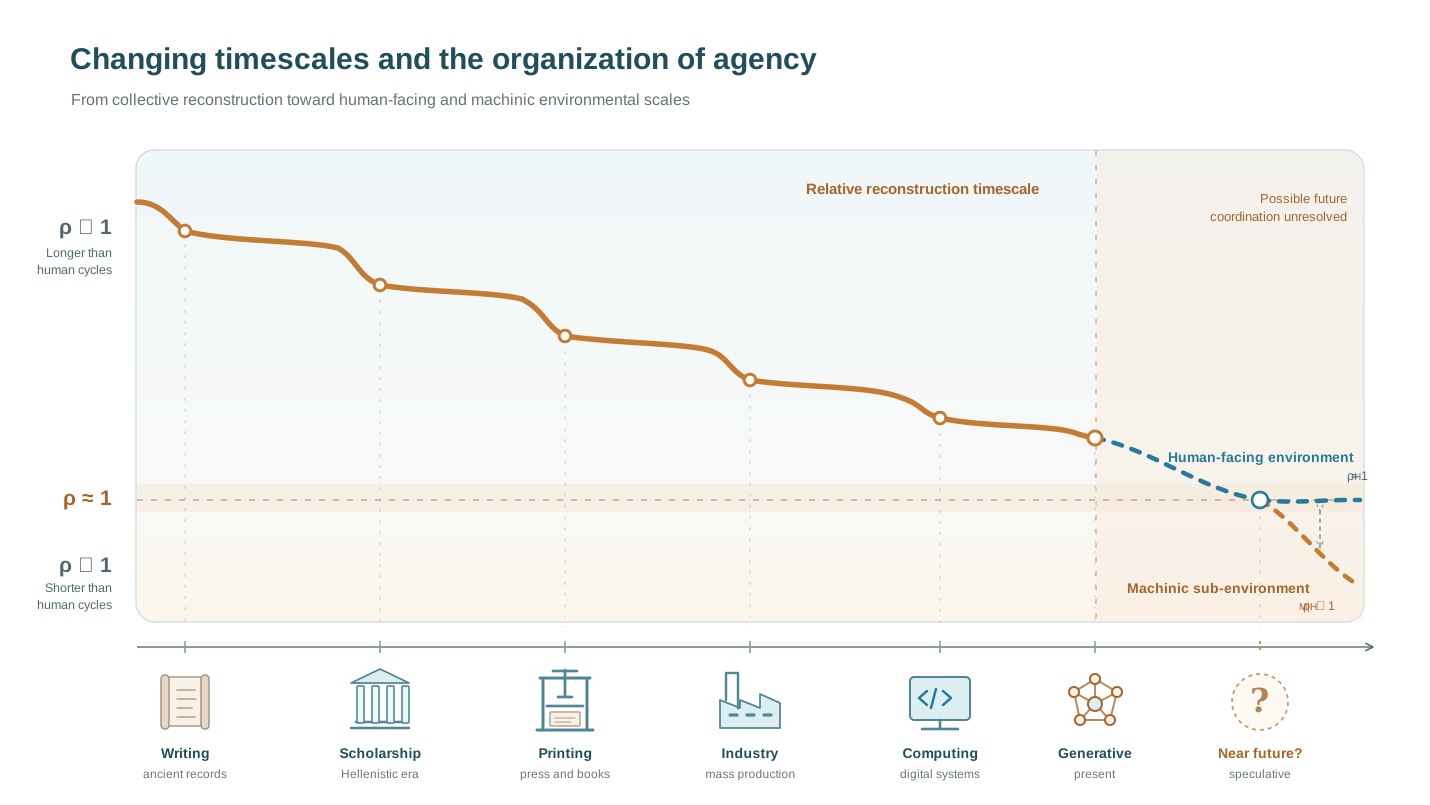
Now reconstruction may become increasingly rapid relative to the human without being particularly rapid relative to the machinic activity it supports. What appears to us as a single operation might contain extensive internal processes of construction, evaluation, and revision. This suggests that environmental reconstruction doesn’t need to be limited to one process steadily increasing in speed. A broader environment can contain multiple sub-environments, each organized around different timescales.
A possible bifurcation and two potential worlds
This is all speculation, but it introduces an interesting possibility. For most of our history, substantial changes to intellectual environments depended on collective human activity. Institutions, scholarly communities, and generations of accumulated work provided the coordination necessary to construct and reorganize the conditions of future work. As technology reduces the difficulty of creating and modifying tools, we become increasingly capable of reconstructing our immediate intellectual environments. This timescale contracts toward the duration of individual creative activity.
But further acceleration might not simply produce a more responsive version of the same environment. As machinic processes become capable of reconstructing their working conditions more rapidly than humans can participate directly, a differentiation of environments becomes likely. Our environment remains organized around human attention, intention, and evaluation. Another contains increasingly elaborate internal processes operating at much shorter timescales.
We might describe this as a kind of environmental bifurcation in the organization of agency. Not necessarily a mathematical bifurcation in the strict dynamical sense, but a branching in the scales at which environmental reconstruction can occur. There is an important distinction, though. The differentiation of environmental timescales does not necessarily imply their decoupling. The emergence of increasingly independent machinic processes could support substantially different relationships with the human environments in which they originate.
This suggests two possible directions of development.
In one possible world, machinic environments become increasingly elaborate and internally organized, but progressively less intelligible to the humans who initiate their activity. Their artifacts, tools, and practices may develop primarily in relation to other machinic processes. The internal organization of these environments becomes increasingly difficult to interpret, while their operations grow faster and more complex. We might continue to establish broad objectives or receive completed results, but increasingly lose the ability to understand how those results emerge, evaluate important internal transformations, or meaningfully redirect the processes involved.
There is a distinction here between two forms of separation. The first is temporal: machinic processes operate more rapidly than our attention can follow. This is not completely new, of course, and has been a factor for several generations, but is new in regard to environmental influence. The second is probably most important—organizational or semantic separation: the relationships between machinic activity and our intentions become increasingly difficult to understand and influence. The former does not necessarily require the latter. A widening difference in timescales might create conditions in which this second form of decoupling becomes more likely.
The concern is not simply that an artificial system becomes more capable or autonomous. It is that the environment within which it exercises those capacities may become increasingly disconnected from the intentions of the people who depend upon it. The initial enhancement of our own agency might reverse, a kind of regression. Formerly, we required teams of specialists to understand the slower machinic world; we might then enter a window of generalized specialization where human agency feels ideal, only for it to regress as the machinic environment overwhelms.
But another possibility exists.
| Decoupled environments | Coordinated environments | |
|---|---|---|
| Machinic activity | Increasingly self-organizing | Increasingly self-organizing |
| Human participation | Primarily external supervision | Active participation through higher-level interfaces |
| Intellectual environments | Diverging human and machinic structures | Distinct but reciprocally connected structures |
| Legibility | Declining understanding of internal organization | Selective, meaningful representations of internal activity |
| Principal constraint | Loss of effective human direction | Design of coordination across timescales |
| Resulting agency | Increasingly difficult to direct or evaluate | Potentially expanded through machinic capabilities |
In a coordinated environment, machinic processes can develop their own tools, representations, and practices while still being meaningfully connected to our own intentions, intuitions, and desires. We don’t need to observe or direct every internal operation. Requiring such direct participation would eliminate much of the benefit of organizing activity across different timescales. Instead, coordination depends upon the relationships maintained between these environments, and perhaps on new coordination artifacts between them, which themselves become tools for environmental cohesion.
Our intentions must remain capable of shaping the activity of machinic processes. The consequences of that activity must become available in forms that we can evaluate and understand. Our evaluation must, in turn, be capable of influencing the continued development and organization of the underlying system. The machinic environment will become enormously complex, yet its relationship to human agency can remain productive.
In this case, increasing internal complexity need not diminish human agency. It may extend the range of activities that an individual can intentionally pursue.
Coordination and productive mediation
The distinction between these possible worlds cannot be determined by our original ratio alone. Both might involve machinic processes operating at timescales much shorter than human activity:
The more important difference concerns the organization of the relationships between environments. We could describe coordination as the preservation of meaningful relationships between intention, activity, feedback, and revision across different scales of agency. This needs more than the existence of communication channels or the ability to issue instructions. A system will respond to commands while remaining difficult to evaluate or redirect. Conversely, an environment can contain processes that are not well understood, yet still allow effective participation. These conditions exist in human-human coordination, with different levels of mediation required to help cooperate within or between environments. This new problem is similar to that but taken to extremes.
Coordination therefore doesn’t need complete transparency into every possible internal operation. When we participate in large institutions, no individual possesses complete knowledge of their internal organization. Scientific communities, libraries, and universities contain extensive networks of activity beyond the immediate understanding of any one person. Despite this, people exercise meaningful agency through these institutions because they provide processes that become artifacts and tools for coordination.
The emergence of machinic sub-environments may generalize this familiar problem of collective organization into a new domain, one where the participants operate at radically different timescales. This brings us back to the distinction between artifacts, tools, and practices. Artifacts may provide representations through which activity in one environment becomes intelligible within another. Tools may provide the means for intentions formed at one scale to influence activity at another. Practices may establish recurring methods of evaluation, correction, and coordination between them.
These mediating structures become important objects of construction in their own right.
The question is therefore not only how _rapidly_we can produce artifacts, nor how much activity can be delegated to autonomous systems offloading repetitive work. It’s how to organize our environments so that their growing complexity remains connected to meaningful human purposes.
The larger distinction is between environments whose complexity remains productively mediated and environments whose complexity becomes disconnected from our intentions. And that brings us right back to our original definition of an intellectual environment—with the added possibility that an environment can contain other environments operating through different forms and timescales.
If so, the continual construction of intellectual environments takes on a broader meaning. It includes not only the creation of artifacts, tools, and practices, but the organization of relationships between the environments they support.
Constructing and maintaining those relationships may itself become a new object of human agency.
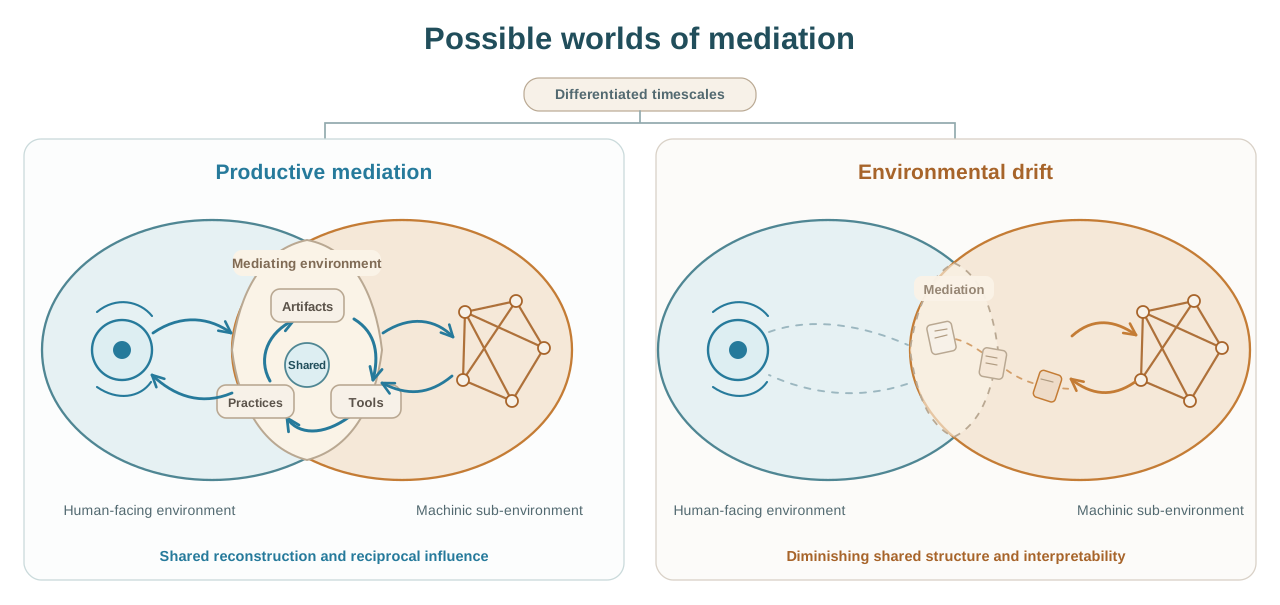
An attempt to explore how those mediating structures might be built through early projects.
What remains is to explore this new space and try to integrate prior work into new applications. In general, I feel that the actual process of creative work needs a kind of grounding to feel continuous: a tangible object to work with, something like ground truth but more structured, iterative, and oriented around human-centered modes of exploration. The shifting, black-box nature of LLMs poorly matches this feeling, instead simulating the ephemeral conversations and thoughts that fill the gaps between that structure. Industry has trended toward some solutions to this lack of structure or ground truth, through additional reinforcement of model behavior or techniques like RAG that attempt to steer the fluid technology. But beyond this, I see a larger picture of a person–researcher–creator approach that can bridge older forms of exploration with the dramatic increase in flexibility we are beginning to have.
As we work in these systems, we will develop new processes, tools, and artifacts that can help create synergy between environments. This is the direction I want to explore in the projects collected here. Their immediate subjects may differ, spanning scientific research, historical interpretation, writing, and software development. But they share an interest in making ideas tangible enough to examine, and in developing the environments through which further questions can emerge. The resulting work may be an essay, a numerical experiment, an interactive application, or simply a better way to organize an existing body of thought. What matters is the possibility of moving between these forms without continually breaking the process of inquiry into separate activities.
There’s a phrase, mixed-initiative research environment, which could describe a working arrangement in which direction and useful suggestions can emerge at different points in the process. I bring interests, questions, experience, and judgments. A model can propose distinctions, interpretations, or implementations. Conventional software can retain sources, perform calculations, and check explicit constraints. The division is adjustable, but the responsibilities need to remain visible. This is particularly interesting when the result of one interaction becomes the working material of the next. A generated program can be inspected and modified. A research note can become a design document. A visualization can generate new questions that alter the original research objective.
The environment itself becomes part of the evolving research process. The central question is how those different capacities can be organized into a productive process. My early attempts at using this approach can be viewed in projects like Thoughtlines or Folio, where I hope to develop software that works and changes as my own writing and research grows. Thoughtlines distinguishes Codex’s contributions as developer, researcher, and author. A code change, a proposed historical relationship, and a paragraph of interpretation need different kinds of review.
I want these projects to become places where interests can develop into sustained work. An essay can suggest a model; building the model can expose a distinction; a visualization can send me back to a passage; that passage can change the essay. Generative systems may make more of this movement possible within the scale of an individual practice. The longer-term aim is to accumulate useful ways of asking, representing, and revising questions—and in particular, to develop the artifacts, tools, and processes that mediate these new forms of creativity. I would like the work to leave me with a clearer understanding of its subject, and with tools and materials through which someone else can pursue it differently.
My immediate essays and projects may be fairly ordinary. But their value doesn’t have to end with the artifact itself. A representation developed to clarify one question may become a tool for exploring another. A collection of notes may become a structured research interface; a program written for one investigation can become part of the process I use when the next program is developed. Through continued use, these artifacts acquire practices around them, and their organization begins to influence what questions can be asked and pursued. The products of inquiry become part of the environment for further inquiry, and that environment can itself be revised.
This brings me back to the recursive relationship between artifacts, tools, environments, and agency I introduced at the start. What may be changing is the degree to which this process can take place. Rather than treating the development of intellectual workflows as something largely separate from research or writing, the construction of that infrastructure can be a part of the creative process itself. An idea leads to a representation, the representation exposes new possibilities or limitations, and the resulting changes to the environment influence what I can do next. The intention is not simply to make more things, or to make them faster, but to develop conditions where my thoughts and creations can continually inform and expand on one another.
Even through early work, I run into the examples of “machinic sub-environments”. If increasingly sophisticated computational processes can construct their own artifacts, tools, and working spaces, then the relationships between these environments become important in their own right. The amount of code, tests, workflows is growing faster than I can reasonably keep up with or review. Already, my traditional IDE is open less and less. Maintaining those relationships will require new kinds of mediating artifacts. Persistent representations of intentions, structures for organizing evidence, methods of evaluating results, and tools through which an investigation can be redirected. Everything doesn’t need surfacing or exposure, but their purpose is to preserve a meaningful relationship between what we intend, what the systems do, what we can understand of the results, and how that understanding changes what happens next. An evolution of older practices, data and software engineering for a new technical world.
I don’t yet know what the most useful forms of this new, mediated, environment might look like. I don’t know how much of their construction can realistically become part of my creative practice. This is what I hope to explore through the work collected here. Faster cycles of production will not necessarily make better questions, clearer understanding, or increase something I would identify as my own agency. The aim is to develop artifacts, tools, and practices that help maintain those relationships as the possibilities for construction expand. The clearest distinction I’ve gained through preliminary work is that a useful result for working in this new mode won’t merely be some new kind of tool, but something more like an evolving environment that makes the next investigation possible. An artifact becomes a tool; tools and practices organize an environment; that environment changes the possibilities for further inquiry. And as environments themselves become increasingly capable of construction and revision, the relationships between them become another object of human agency. The cycle continues, but I hope as something I can participate in deliberately.