Spectral learning of predictive dynamics AI
A predictive representation describes the recent history of a signal by what it helps predict next. In fMRI, this changes the modeling target: instead of finding only the largest fluctuations, we seek a compact set of temporal relationships linking regional activity across successive windows.
What the decomposition learns
Let stack a short history of ROI measurements and stack the following measurements. Their empirical cross-moment, , summarizes relationships between those windows. The past moment describes the scale and redundancy of the histories. These are uncentered moments unless the inputs have been centered.
In the implementation used here, a regularized whitening of the past precedes a singular value decomposition of the cross-moment. Keeping singular directions defines a reduced predictive space. This resembles PCA in its use of an SVD, but the decomposed matrix relates past and future rather than simply measuring variance within one observation vector. The retained singular values therefore are not percentages of BOLD variance explained.
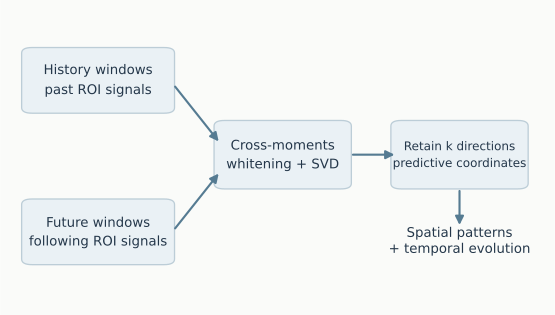
A schematic of the continuous-signal implementation. Rank sets the dimension of the predictive representation.
Where networks enter
A history is mapped into coordinates . Regression then associates these coordinates with observation moments and their evolution. For the spatial readout,
Each is an ROI-by-ROI coefficient pattern, and several patterns contribute simultaneously. Opposing signed weights are part of this linear representation: a negative coordinate reverses the contribution of its entire pattern. They do not independently establish physiological inhibition or anticorrelation.
Predictive-state methods provide a broader framework for representing dynamics through observable predictions; see Boots, Siddiqi and Gordon. The continuous moment model here is an adaptation, so probability guarantees from a particular discrete-state formulation cannot simply be transferred to it. Its predictive value requires evaluation on recordings withheld from fitting.