Comparing subjects in a shared latent basis AI
Two network patterns can refer to exactly the same ROIs while occupying different latent coordinates. Anatomical coordinates say where the measurements live; a latent basis specifies which combinations of those measurements the model uses. This distinction matters whenever components are compared or averaged across people.
Shared anatomy does not fix component identity
Independently fitted decompositions need not assign the same pattern the same component number or sign. For an SVD, paired singular vectors can reverse sign without changing the reconstructed matrix. Similar singular values can also make individual directions sensitive to small perturbations. A component can consequently differ while the space spanned by several components remains similar. See the SVD factorization and conventions.
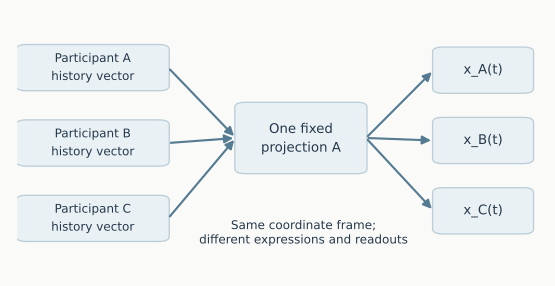
A common projection fixes the coordinate frame. Participant values within that frame can still differ.
What a common fit changes
One approach is to learn a predictive basis from multiple recordings, freeze it, and calibrate participant-specific readouts in that basis. Here each history is mapped by the same transformation, , while participant-specific spatial matrices can differ. This is the approach used for the subject-consistency comparisons: there is no independent subject SVD that would make mode swapping or sign reversal an expected ambiguity.
The resulting question is precise: how does each participant express, or depart from, a common representation? It is different from asking whether independent fits rediscover the same networks.
Comparability has a cost
Structure outside the retained basis can be missed, and a basis learned using the evaluated participant can make in-sample agreement optimistic. A stronger generalization test fits the basis on training participants and applies that fixed transformation to held-out recordings. Independently fitted models instead require explicit alignment and, where components mix, comparisons of subspaces rather than component numbers alone.
Shared representations also appear in other neuroscience methods. Haxby and colleagues’ hyperalignment is a useful comparison: it aligns representational information across people, but uses a different objective and transformations from this shared predictive-basis model.