What might resting state activity be doing AI
Resting state is an acquisition condition with no imposed experimental task. It is not neural inactivity, a single cognitive state, or a synonym for the default-mode network. Sensory, motor, attention and association systems all participate in ongoing activity; wakefulness, eye condition and recent experience help shape the recording.
Intrinsic organization provides a repertoire
Spontaneous correlations can reveal distributed systems resembling those recruited during tasks. Smith and colleagues demonstrated correspondence between resting components and patterns derived from task activations. One interpretation is that intrinsic activity reflects an organized repertoire available for behavior, rather than an otherwise idle brain switched on only by stimulation. Correspondence does not imply that rest and task have identical interactions or functions.
The default-mode idea grew partly from reproducible decreases relative to a baseline during externally directed tasks (Raichle and colleagues). That observation identifies a pattern of task dependence; it does not imply that the associated regions stop working or uniquely define all resting activity.
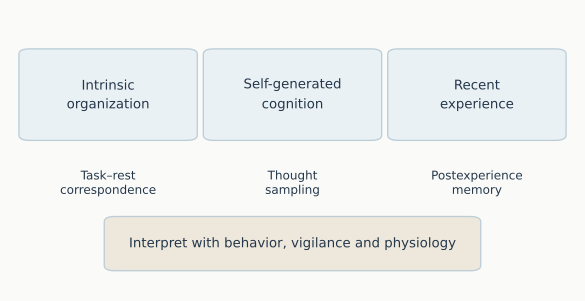
Complementary interpretations supported by different experimental designs, not mutually exclusive states decoded from an unlabeled recording.
Internal cognition and recent experience contribute
Thought-sampling experiments associate default-network activity with stimulus-independent thought (Mason and colleagues). Memory, imagined situations and self-relevant processing provide plausible contributors to activity during rest. They need not occupy the whole recording or involve the default network alone.
A complementary account concerns processing after experience. Tambini and colleagues linked postexperience resting correlations to subsequent memory. This supports a role for ongoing interactions in retaining recent information, while leaving open which mechanisms operate during an unrelated resting scan. The accounts concern different levels—organization, cognitive content and experience-dependent processing—and can coexist.
The recording does not label its own function
BOLD contains hemodynamic, physiological and motion-related contributions as well as signals related to neural activity. Power and colleagues showed that head motion can introduce systematic connectivity patterns. Changes in vigilance are another reason to avoid treating every expression shift as a transition between mental functions.
For an unlabeled resting cohort, a default-mode-associated component gives anatomical context. Its time course alone cannot establish mind-wandering, memory consolidation or internal attention. Those interpretations become testable when supported by thought probes, behavior, controlled experience or other measurements. The defensible starting point is the organization and variability of the measured dynamics.