Parcels and functional systems describe different scales AI
A parcel is a regional unit for summarizing measurements. A functional system groups regions with related large-scale organization. A learned network is a pattern estimated by an analysis. Keeping these three meanings separate helps avoid mistaking an atlas label for a discovered result.
Local units can belong to distributed systems
Parcellation divides tissue into spatial units; averaging within a parcel produces one regional time series. Coarser parcels reduce dimensionality but can combine heterogeneous signals. Finer parcels preserve more local distinctions while increasing the number of relationships to estimate.
The Schaefer parcellation offers cortical resolutions with assignments to reference systems. Multiple spatially separated parcels can share a system label. Thus a 100-parcel analysis with a seven-system reference contains 100 measurement units grouped anatomically, not seven observations.
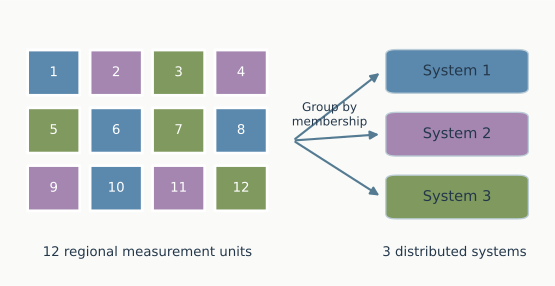
Illustrative parcels and system memberships. The diagram is not an anatomical atlas.
A reference is an organizing vocabulary
Yeo and colleagues estimated broad seven-network and finer seventeen-network cortical organizations from intrinsic functional connectivity. These resolutions offer complementary detail; the finer solution is not a perfectly nested subdivision of the coarser one.
A parcel’s reference assignment supplies a comparison label, not proof of that parcel’s function in every person or condition. Boundaries and memberships can depend on the atlas, alignment and scale. Cortical-only parcellations also omit subcortical structures, so full cortical coverage is not whole-brain coverage.
Learned patterns can cross the reference boundaries
A dynamical component can span several systems, emphasize a subset of one, or place different systems on opposing signed poles. Reference matching asks how its spatial footprint relates to an established organization; it need not yield a unique system name for every component.
Changing from seven to seventeen reference labels changes that anatomical question without necessarily changing the underlying ROI signals or fitted model. Changing the parcel resolution changes the observations themselves and generally requires extraction and model fitting again. These are different design choices and should remain distinguishable when comparing studies.