The magnitude of a component answers how large its modeled contribution is, regardless of sign. Explained variance asks how much variation in a specified target a model accounts for. These quantities coincide only under particular assumptions; a large component need not account for a correspondingly large share of the observed signal.
Pair the coordinate with its spatial pattern
For a network matrix and coefficient , the contribution is . Let contain the unique off-diagonal entries of . The reports summarize contribution magnitude as
This combines expression amplitude with spatial scale. Rescaling by a nonzero scalar and inversely rescaling leaves the contribution and this magnitude unchanged. Comparing coordinate amplitudes alone would not have that property. A signed average addresses a different question: opposing expressions can cancel even when magnitude is substantial.
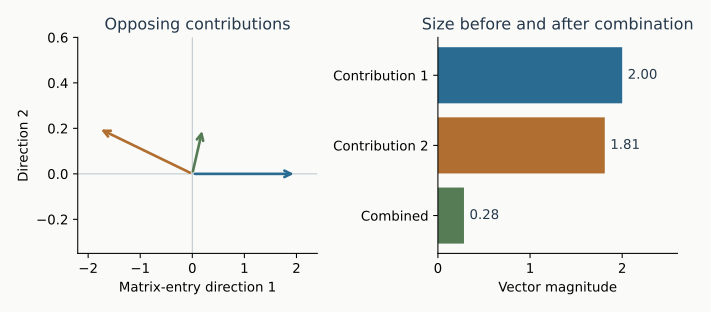
Illustrative vectors in the space of matrix entries. Large component magnitudes can coexist with a small combined contribution.
Components need not provide additive shares
For contributions represented as vectors, the combined squared norm includes cross-terms:
Patterns can reinforce or cancel. Dividing each component magnitude by the sum of magnitudes creates a descriptive allocation, not a decomposition of BOLD variance. The norm here is also measured in the model’s moment space, which is different from the original signal space.
PCA’s explained-variance ratios have a specific centered, orthogonal decomposition behind them (PCA reference). The coefficient matrices of a predictive moment model do not inherit that accounting merely because an SVD appears during training.
To evaluate predictive value, specify a target and score reconstruction or forecast errors on held-out recordings. Removing a component with the other parameters fixed tests a different question from removing it and refitting the model. Either analysis needs its own denominator and interpretation; neither should be presented as a variance percentage derived from magnitude alone.