Continuous dynamics and discrete states AI
An arrow between two learned components can mean very different things. In a discrete-state model it may represent the probability of changing states. In a continuous representation it may describe how one numerical coordinate enters the prediction of another. Similar-looking graphs do not make the underlying models equivalent.
A discrete model assigns state probabilities
In a conventional HMM, an unobserved variable occupies one of a finite set of states. Its transition matrix contains quantities such as : nonnegative probabilities that sum to one across destinations. Observations are drawn from the distribution associated with the current state. The hmmlearn tutorial sets out this structure.
Inference can assign soft posterior probabilities to several states at a time. These describe uncertainty about the hidden state; they do not turn the conventional HMM into a simultaneous sum of independently expressed network components.
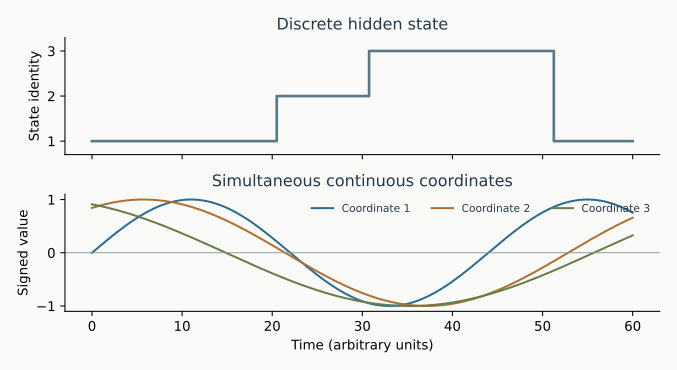
Illustrative state assignments and signed coordinates. The vertical scales encode different quantities.
A continuous representation combines coordinates
A continuous latent vector can have several nonzero, signed entries. In the spatial readout , the coordinates scale overlapping patterns together. A negative value reverses a component’s contribution rather than making it a negative probability.
The spectral model also contains an observation-conditioned update tensor. The report’s ROI-averaged operator summarizes some of its coefficients, but the full update additionally depends on the observation, current coordinates and a moment correction. Its arrows therefore do not constitute an autonomous Markov transition law or anatomical pathways.
Normalization cannot supply a missing probability model
Taking absolute coefficient values and normalizing them to sum to one produces a relative weight allocation. It removes signs and does not establish state occupancy or switching probabilities. Those interpretations require defined states, an observation model and an estimation procedure appropriate to that question.
Recurring combinations of continuous expressions could instead be clustered or modeled with an HMM, followed by transition estimation within continuous runs. That would be a second model with additional assumptions, not a probability interpretation recovered merely by rescaling the first operator.