What different connectivity measures ask AI
“Connectivity” can refer to an anatomical connection, a statistical relationship, or an influence defined within a generative model. Choosing an estimator is therefore part of specifying the scientific question, rather than simply choosing how to color a matrix.
Association between two signals
Pearson correlation measures whether two centered time series rise and fall together, normalized by their variability. Covariance retains amplitude units. Both summarize a selected interval; neither explains why the relationship occurs. A shared input can make two regions correlated without a direct connection between them.
Partial correlation asks whether a linear association remains after accounting for a specified set of other signals. In a multivariate Gaussian model it relates to the inverse covariance matrix. Finite samples, regularization and omitted variables matter: conditional association is not proof of a direct anatomical or causal link. Smith and colleagues evaluated several network estimators in fMRI simulations, emphasizing that method performance depends on the modeled setting.
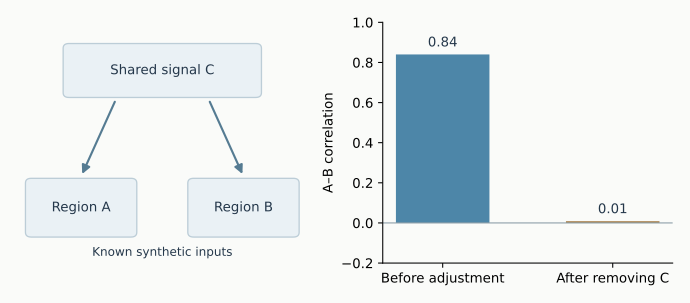
Synthetic common-input example. Adjusting for the measured common signal changes the question; an unmeasured source would remain unresolved.
Relationships can depend on frequency or time
Coherence measures a normalized cross-spectral relationship at particular frequencies (SciPy definition). It can distinguish frequency-specific coupling that a single whole-run correlation obscures. It still requires sufficient data and does not establish direction or causation.
Lagged relationships and directed models ask further questions about temporal order or model-based influence. BOLD timing differences can arise from hemodynamics as well as neural processes, so an apparent delay alone cannot identify information flow. Effective-connectivity models add explicit assumptions about how regional activity and observations are generated.
The estimator and the comparison must agree
Nilearn’s connectivity interface exposes covariance, correlation, precision and partial-correlation estimates as distinct outputs. Agreement across estimators is informative, but each remains tied to its assumptions and preprocessing.
One additional distinction matters here: regional Pearson similarity in the network-matching table compares a spatial weight profile with reference-system membership. It is not temporal correlation between two ROI signals. The learned moment coefficients and predictive operators are yet other quantities. Calling all three “connectivity” would hide their different inputs and interpretations.