Clustering regions and detecting graph communities AI
Clustering groups objects according to a definition of similarity. Graph community detection groups nodes according to the organization of their edges. These questions often overlap, but need not yield the same partition: regions can have similar connections to the rest of the brain without being strongly connected to one another.
Decide what is being grouped
Clustering ROI time courses groups temporal profiles. Clustering rows of a connectivity matrix groups connection profiles. Clustering participants groups people using selected features. The choice of distance, scaling and features defines what “similar” means; the cluster label alone does not supply a functional interpretation.
Community detection instead starts with a graph. For modularity-based methods, a partition is evaluated by how its within-community weights differ from a specified null expectation. Louvain is a widely used optimization approach; Leiden adds a refinement procedure to improve the connectivity properties of detected communities.
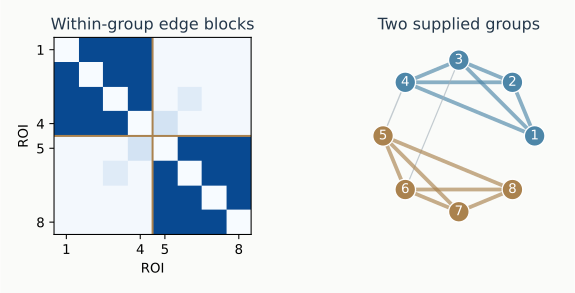
Illustrative within-group organization. Coloring a graph by a supplied partition is not itself evidence that the partition was recovered from data.
Partitions depend on scale and assumptions
Resolution settings, edge density and the treatment of negative weights can change the groups found. Modularity has a documented resolution limit: some smaller groups can be merged because of the global objective. A higher score therefore does not guarantee a unique or biologically preferred decomposition.
Useful checks include repeated optimization, variation across recording samples, alternative resolutions and comparison with appropriate null models. A coassignment matrix records how often each pair of regions falls in the same group. Unlike averaging arbitrary numeric cluster labels, it preserves the relationship a partition actually encodes.
Components and communities are different objects
A learned dynamical component can place weights across several communities, and several components can involve the same system. ICA components, spectral predictive coordinates and graph communities do not have to correspond one-to-one.
Reference-system matching in this project asks how a learned pattern relates to an external cortical organization. It does not rediscover that organization by community detection. Community analysis would be a complementary investigation of how the pattern’s edges organize, with an explicit objective suitable for its signed coefficient weights.