Choosing the rank of a dynamical model AI
Rank determines how many directions a reduced representation retains. Too few can merge distinct relationships; too many can preserve weakly estimated structure. In a dynamical model, the useful dimension depends on the predictive question and available recordings, not on how many familiar network names an atlas provides.
A spectrum describes one estimation problem
Spectral learning decomposes a matrix relating histories to subsequent observations, after a specified normalization or whitening. Its singular values describe the strength of directions in that matrix. They are not automatically fractions of BOLD variance explained. PCA has a different variance interpretation because it decomposes centered observations in a particular way; see the PCA documentation.
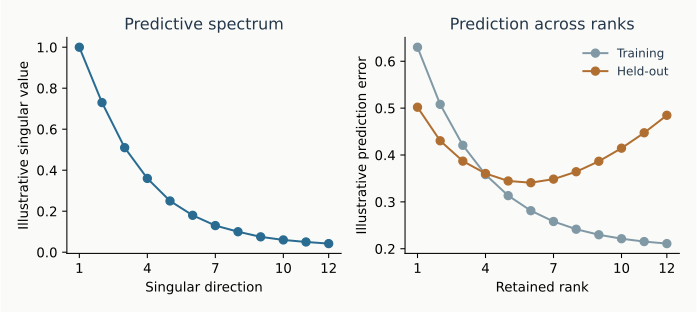
Schematic diagnostics, not a rank recommendation for either study. A smaller training error alone is insufficient evidence for retaining more dimensions.
Changing rank changes the fitted representation
With identical moments, the leading singular subspaces can be nested as more directions are retained. However, downstream regressions use the retained coordinates jointly. Increasing rank can therefore change spatial readouts and fitted interactions rather than simply append an untouched network to the previous model. Close singular values can also make individual directions unstable while their joint subspace remains similar.
A component’s number is consequently not a durable biological identity across fitted ranks. Matching anatomy or comparing subspaces is more informative than assuming, for example, that component 6 has an identical role in every fit.
Prediction and stability address different costs
A useful rank comparison holds preprocessing, participant membership and evaluation targets fixed. Fit on training recordings, then compare prediction on held-out runs or participants against meaningful baselines such as persistence. Splitting whole recordings avoids placing strongly overlapping temporal windows on both sides of the evaluation.
Alongside prediction, examine repeated-fit stability and whether additional components provide reproducible, interpretable structure. A rank chosen for an exploratory figure remains a design choice; selecting it because its maps look familiar does not independently validate the functional labels. Additional data used to choose the rank should not also serve as an untouched final test set.