What block and resting state designs reveal about dynamics AI
Resting-state and block-design recordings can both contain changing network expression. Their main difference for interpretation is the availability of an external experimental clock. A block schedule provides repeated occasions to ask whether a change accompanies a known manipulation; resting-state data provide no equivalent labels for the participant’s ongoing cognition.
A schedule supports alignment and contrasts
In a block design, repeated onset and offset times support aligned trajectories and within-participant contrasts. Averaging across repetitions can expose a systematic response, while obscuring differences among individual blocks. A condition-average difference also need not reveal a change in dynamics: it may reflect a sustained shift in one component. Trajectory shape, temporal variability and fitted interactions ask further questions.
Resting recordings instead support questions about spontaneous organization, persistence and variability. Early work demonstrated correlated motor-region fluctuations without a task (Biswal and colleagues); identifying a fluctuation does not by itself identify the mental activity accompanying it.
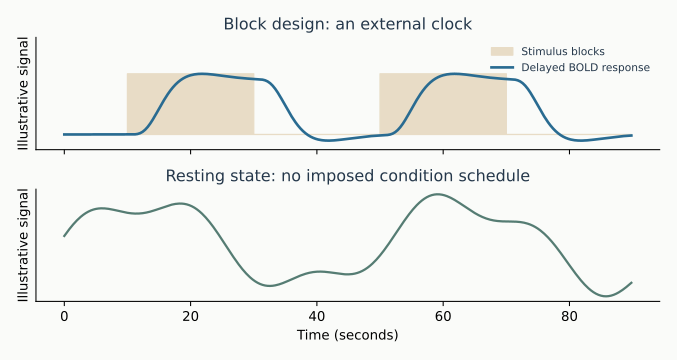
Schematic signals, not participant data. The measured response extends across stimulus boundaries; the resting trace has no externally assigned state labels.
The BOLD clock is not the stimulus clock
Hemodynamic responses are delayed and temporally spread, with variation across people and regions (Handwerker, Ollinger and D’Esposito). Long blocks can support stable condition averages, but onset and offset dynamics remain sensitive to which samples are assigned to each period.
Shifting comparison windows or retaining only block interiors changes the estimand: the former samples a delayed interval, while the latter emphasizes sustained expression. Comparing these choices tests timing sensitivity; it does not establish the true neural delay. Continuous recordings should remain continuous during fitting, because joining disconnected blocks invents temporal neighbors.
Fixation is a contextual baseline
Fixation between task blocks retains the acquisition context, anticipation and preceding response. It is useful for a within-run contrast, but does not create an interchangeable resting-state dataset. A task–fixation difference supports an association with those experimental periods. Stronger claims about specific cognition require the controls and behavioral measurements to distinguish competing explanations.