Personal calibration and later-beat evaluation AI
Personal calibration means learning from a person’s early waveform features paired with measured reference pressure. It uses multiple heartbeats, not a single cuff reading. Each pressure estimate concerns the completed current beat window; it is not a forecast of the next beat.
Five-beat smoothing
All transformed inputs and reference pressures use full trailing five-cycle means. For a series v, the value at beat t averages beats t−4 through t. A missing value invalidates that feature’s whole five-cycle window before training-only imputation. Original beat positions are retained.
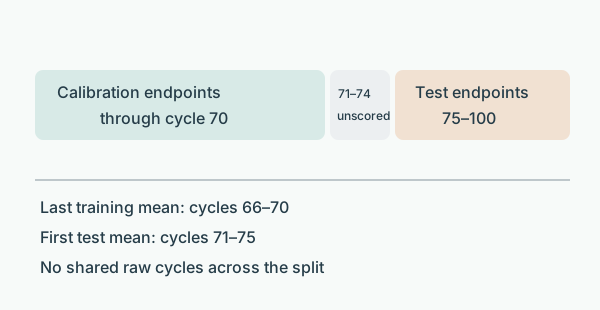
Calibration windows end through cycle 70. Endpoints 71–74 are unscored. The first test window ends at cycle 75 and uses raw cycles 71–75, so it shares no raw cycles with calibration. Later test windows overlap each other. There are 1,030 valid windows across 40 participants.
Learning and tuning
Imputation, centering, SD scaling and median waveform templates are learned within the relevant training data. Chronological tuning splits train through cycles 30, 42 or 54, with validation windows ending at 35–44, 47–56 or 59–68. A fold needs at least 20 fitting windows and five validation windows; X1039 lacks enough rows for the first fold. Test pressure never updates preprocessing or selects penalties within this procedure.
A constant-pressure sanity check
The check repeats each person’s average valid calibration SBP/DBP for every test window. It uses reference BP only and no predictive waveform features. ECG supplies the common cycle boundaries, not a sensor-based pressure prediction. It asks whether the model improves on simply remembering early pressure.
This is later-beat evaluation in the same recording and personally calibrated people, not leave-one-person-out evaluation or long-term validation. See personal ridge, cohort sharing and validation context.