Blood pressure: systolic and diastolic AI
Blood pressure describes the pressure of blood against arterial walls. Within each heartbeat, systolic pressure (SBP) is the highest pressure and diastolic pressure (DBP) is the lowest. A reading of 120/80 mmHg gives the systolic value first. Millimeters of mercury (mmHg) are pressure units, not units of electrical or optical sensor amplitude. NHLBI’s explanation provides broader clinical context.
Two targets from one waveform
In this project, the reference is a continuous reconstructed brachial-pressure waveform. Its maximum and minimum within an ECG-defined cycle supply the two targets. The model then estimates these pressures from separate electrical, optical and mechanical recordings. It does not read pressure directly from those sensors.
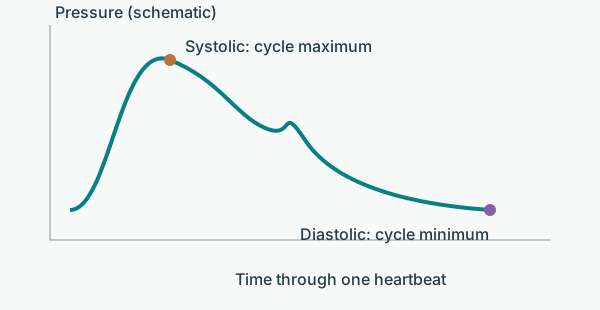
The figure is explanatory, not a participant recording or a diagnostic threshold. Actual reference measurements and model errors are described in recordings and reference pressure and prediction errors.
Pressure varies from beat to beat. The prediction comparison uses trailing five-beat averages, so its target is a short average of systolic or diastolic values rather than every unsmoothed peak and trough. See calibration and later-beat evaluation.